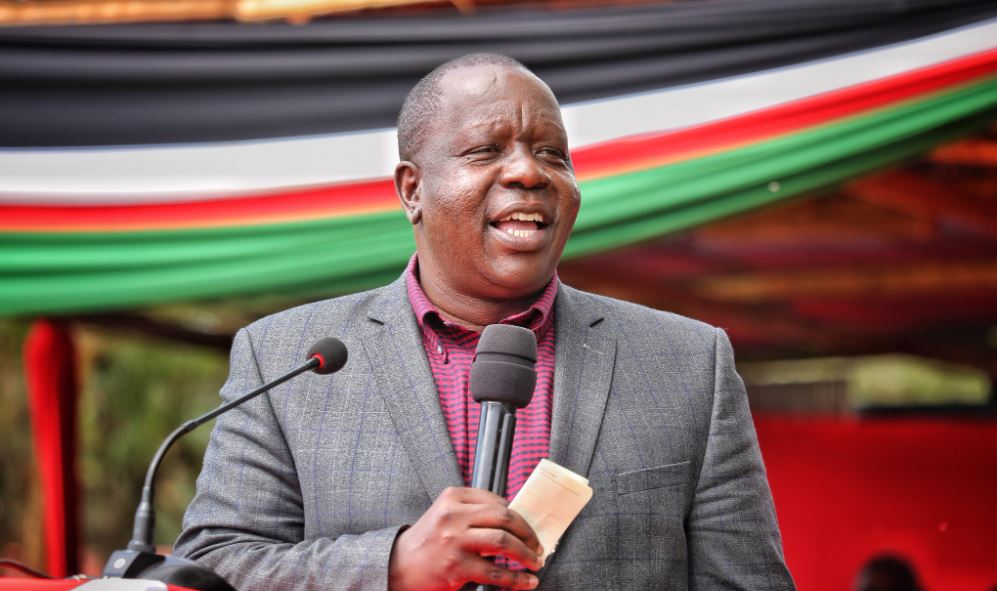
Fred Matiang’i Explains Why He and Kalonzo Are Taking a Different Route to 2027
Former Interior Cabinet Secretary Fred Matiang’i has offered an explanation for the relatively low-key public appearances of his political partnership with Wiper leader Kalonzo Musyoka as Kenya moves closer to the 2027 General Election.
While several opposition figures have been holding large rallies and making frequent public appearances, Matiang’i says his preferred approach is different. Rather than spending most of his time addressing crowds from campaign vehicles, he says he would rather meet people directly, discuss their problems and develop practical solutions.
The comments have added a new dimension to the growing debate over how Kenya’s opposition should organise itself ahead of the next presidential election.
Matiang’i explains his campaign strategy
Speaking during a live interview on August 10, Matiang’i said politicians have different approaches to political mobilisation.
He explained that appearing on top of campaign vehicles and addressing large crowds is not his preferred way of interacting with voters.
Instead, the former CS said he is more comfortable sitting down with citizens, listening to their concerns and discussing issues affecting their communities.
The strategy could represent a deliberate attempt to build political support away from the highly visible rallies that have traditionally characterised Kenyan election campaigns.
Matiang’i argued that political work should ultimately be measured by the solutions offered to citizens rather than the number of speeches delivered at public gatherings.
Why Matiang’i invoked Mwai Kibaki
During the interview, Matiang’i referred to former President Mwai Kibaki as an example of a politician whose public style was considerably different from that of some modern political leaders.
According to Matiang’i, Kibaki was not known for spending long periods addressing crowds. The former president’s public remarks were often relatively brief, except during major national events or occasions when he addressed people from a vehicle.
For Matiang’i, the example illustrates his belief that political leadership does not necessarily require constant public appearances.
His argument is that the important question is whether leaders are doing the work required to influence people’s lives, rather than simply generating political excitement.
Social media is changing political mobilisation
Matiang’i also pointed to social media as another reason why traditional rallies may no longer be the only effective way to reach voters.
He suggested that a political message posted online and viewed by tens of thousands of people could potentially reach a larger audience than a single physical rally.
That approach is particularly relevant as Kenyan politics increasingly incorporates digital platforms into campaigning.
Young voters, in particular, consume political information through social media, livestreams, short videos and online discussions. Consequently, political mobilisation is no longer limited to physical gatherings.
Matiang’i’s comments therefore suggest that his team may be attempting to combine direct community engagement with digital communication rather than relying heavily on conventional rallies.
Matiang’i and Kalonzo remain important figures in opposition politics
The discussion comes as both Matiang’i and Kalonzo remain central figures in the race to determine who could lead a united opposition ticket against President William Ruto in 2027.
A July Infotrak survey placed Kalonzo slightly ahead of Matiang’i among opposition supporters.
Kalonzo recorded 27 per cent support compared with Matiang’i’s 26 per cent. Nairobi Senator Edwin Sifuna followed with 19 per cent, while former Deputy President Rigathi Gachagua had 9 per cent.
The figures demonstrate how closely contested the opposition’s internal race remains.
Neither Kalonzo nor Matiang’i has established an overwhelming lead, leaving considerable room for negotiations, alliances and changes in voter preferences before the 2027 election.
Matiang’i is quietly building grassroots networks
Although Matiang’i has not been appearing at rallies as frequently as some of his political competitors, reports indicate that he has not been politically inactive.
In July, Borabu parliamentary aspirant Morara Kebaso claimed that Matiang’i had held meetings with more than 10,000 opinion shapers across the Mt Kenya region.
The figure was not independently verified, and Matiang’i’s campaign had not published its own cumulative attendance figures. However, the report highlighted the former CS’s emphasis on grassroots engagement.
Matiang’i has reportedly been holding meetings with women leaders, political aspirants and community groups while working to strengthen Jubilee Party structures.
His campaign has previously indicated that it intends to rely heavily on ward-level and household-to-household mobilisation.
That approach could explain why his political activities have sometimes attracted less attention than large opposition rallies.
The opposition is undergoing a major realignment
Matiang’i’s comments come at a significant moment for the opposition.
Azimio la Umoja-One Kenya Coalition has been restructuring its leadership and seeking to broaden its political base ahead of 2027.
On August 3, Azimio announced the admission of Matiang’i, former Meru Governor Peter Munya and Embu Senator Lenny Kivuti into its governing council.
The coalition also announced plans to rebrand and reorganise its structures as it seeks to reposition itself following the death of former Prime Minister Raila Odinga.
Kalonzo, who leads the coalition, has also disclosed discussions with several political formations and personalities, including former Deputy President Rigathi Gachagua’s Democracy for Citizens Party and Martha Karua’s People’s Liberation Party.
The coalition has additionally been engaging former Chief Justice David Maraga and other emerging political movements.
These developments indicate that opposition politics is moving towards a broader alliance-building phase.
A potential Matiang’i-Kalonzo combination remains possible
The relationship between Matiang’i and Kalonzo is particularly significant because both politicians have emerged as leading contenders within the opposition.
The possibility of the two working together has attracted attention because they could potentially bring different geographical and political constituencies into a common arrangement.
Kalonzo has an established political base in Eastern Kenya and decades of experience in national politics, while Matiang’i has been attempting to expand his support across several regions.
However, the question of who would lead a presidential ticket and who would take the running-mate position remains unresolved.
Recent polling also demonstrates that public preferences are fluid.
A WANTAM online vote reported in early August placed Nairobi Senator Edwin Sifuna ahead in the presidential category, while Matiang’i emerged as the leading choice in the running-mate category.
Sifuna received 58 per cent in that particular online presidential ballot, followed by Kalonzo at 34.01 per cent. Matiang’i received 31 per cent in the running-mate category, ahead of Sifuna at 29 per cent.
The results should not be interpreted as a definitive prediction of the 2027 election because the exercise was an online opposition-focused vote rather than a national scientific election poll.
Nevertheless, they illustrate the intense competition within the opposition.
The challenge of choosing one candidate
One of the biggest challenges facing Kenya’s opposition is the need to avoid splitting its vote among several presidential candidates.
With Kalonzo, Matiang’i, Sifuna, Gachagua, Maraga and other figures attracting varying levels of support, negotiations over a common ticket are likely to become increasingly important.
A fragmented opposition could make it easier for the incumbent to retain power, while a broadly supported candidate could present a stronger challenge.
The difficulty, however, is that each major political figure has supporters, party structures and personal ambitions.
Reaching an agreement will therefore require more than simply identifying the most popular candidate. The opposition will also have to negotiate positions, regional representation, policy priorities and campaign structures.
Matiang’i’s quiet approach could be a calculated strategy
Matiang’i’s decision to avoid constant rallies could ultimately prove either advantageous or risky.
On one hand, grassroots meetings allow politicians to establish deeper relationships with community leaders and local networks. Such networks can become particularly important during an election because they provide mobilisation structures at ward and constituency levels.
On the other hand, large rallies offer visibility and demonstrate political strength.
They create images that dominate television broadcasts and social media, helping candidates remain at the centre of public conversation.
Matiang’i therefore faces the challenge of ensuring that his quieter approach does not make him appear politically inactive.
The 2027 contest is entering a new phase
With the 2027 election approaching, Kenya’s political competition is gradually moving beyond individual declarations and into coalition-building.
For Matiang’i, the immediate task is likely to be consolidating his support base while maintaining his position within the broader opposition negotiations.
For Kalonzo, the challenge will be balancing his presidential ambitions with the need to bring together competing opposition groups.
And for the wider opposition, the crucial question will be whether its leading figures can agree on a common strategy before the election campaign reaches its most intense stage.
Matiang’i’s explanation offers an insight into one possible model: build quietly, engage communities directly, use digital platforms and focus political messaging on issues rather than spectacle.
Whether that approach can translate into votes will become clearer as the 2027 election approaches.
For now, the former CS is making it clear that his absence from some of the biggest political rallies should not be interpreted as an absence from the political battlefield.